Psychiatrist in Lucknow | Happy Minds
Time: (Mon,Wed&Fri) 6pm to 9pm, (Tue,Thurs&Sat) 4pm to 9pm, Sunday 10am to 2:00 pm

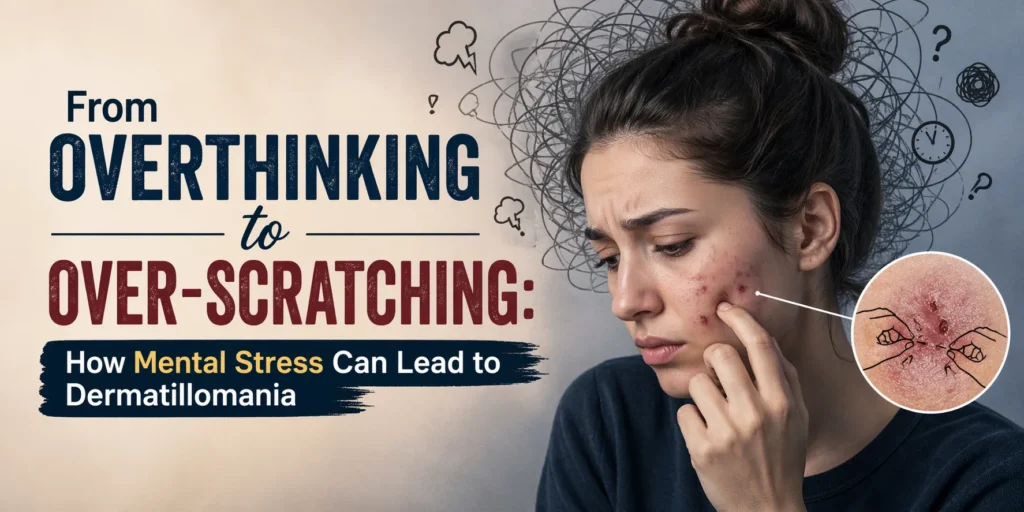
From Overthinking to Over-Scratching: How Mental Stress Can Lead to Dermatillomania
When Stress Doesn't Stay in Your Mind
Most people think of stress as something that lives entirely in the mind — a restless night, a racing heart, a head full of worries that won’t quiet down. But stress is rarely that polite. It bleeds into the body in ways we do not always notice immediately. Tight shoulders, a clenched jaw, an upset stomach, disrupted sleep — these are all familiar signs that the mind’s burden has become the body’s problem too.
One of the lesser-discussed ways stress manifests physically is through the skin. And not just in the form of breakouts or rashes. For a significant number of people, emotional and mental pressure quietly fuels a pattern of compulsive skin picking — often without them even realising it is happening. You are sitting at your desk, anxious about a deadline, and before you know it, you have been picking at a small scab on your arm for twenty minutes. You did not decide to do it. It just happened.
This crossover between mental health and skin health is at the heart of a condition called dermatillomania. It is both a psychological concern and a dermatological one, and understanding it requires looking at both sides honestly.
What Is Dermatillomania?
A Simple Definition
Dermatillomania, also known as excoriation disorder, is a condition characterised by the repetitive and compulsive picking of one’s own skin. This can involve picking at acne, scabs, cuticles, or even completely healthy, unblemished skin. It is classified as a body-focused repetitive behaviour (BFRB) and is closely related to OCD-spectrum disorders.
Here is the important distinction: this is not a bad habit. Calling it a bad habit is like calling anxiety “just overthinking.” The label minimises something that is deeply rooted in brain chemistry, emotional regulation, and compulsive behaviour patterns. People with dermatillomania are not picking their skin because they are careless or vain — they are doing it because their nervous system has found a way to cope with internal tension that they often cannot fully control.
Common Signs You Shouldn’t Ignore
Dermatillomania can look different from person to person, but there are some consistent signs worth paying attention to. Repeated picking of pimples, scabs, or normal skin — especially in the same spots — is a key indicator. Many people find themselves picking during specific situations: when they are on a phone call, watching television, reading, or lying in bed unable to sleep.
One of the most telling signs is the inability to stop even when fully aware of what you are doing. You might notice mid-pick that you are doing it, feel a flash of frustration, and still continue. Visible marks, open sores, scarring, and frequent skin infections are also common physical consequences that signal this has moved beyond an occasional nervous habit into something that needs proper attention.
The Psychology Behind It: How Overthinking Turns into Skin Picking
The Stress–Anxiety Loop
To understand why skin picking happens, you need to understand what anxiety does to the body. When you are anxious or overwhelmed, your nervous system builds up internal tension — a kind of psychological pressure that needs somewhere to go. For many people, picking the skin provides a momentary release from that pressure. The physical sensation interrupts the mental spiral, even just briefly, and offers a fleeting sense of control or relief.
This is why dermatillomania often intensifies during stressful periods. The brain learns — unconsciously — that picking produces relief. So it keeps returning to that behaviour whenever tension rises. Over time, this loop becomes deeply wired. The anxiety triggers the urge, the picking reduces the anxiety temporarily, and the cycle reinforces itself each time it plays out.
Triggers That Make It Worse
Overthinking is one of the most common triggers. When the mind is spinning — replaying conversations, catastrophising outcomes, or searching for solutions to unsolvable problems — the body looks for an outlet. Skin picking often fills that role.
Boredom is another underappreciated trigger. When the brain is understimulated, it seeks sensation, and picking provides that without requiring any effort. Perfectionism also plays a role, particularly when people become fixated on imperfections in their skin and feel compelled to “fix” them. Emotional distress rooted in work pressure, relationship difficulties, grief, or financial stress can all dramatically intensify picking behaviours. The more overwhelmed a person feels internally, the more frequently they may reach for this physical coping mechanism — even if it makes things worse in the long run.
The Skin Impact: More Than Just Surface Damage
Short-Term Effects
The immediate aftermath of a picking episode is rarely dramatic enough to feel alarming, which is partly why the behaviour continues. Redness and localised swelling are typical short-term effects, along with minor wounds, bleeding, and skin irritation. In the moment, these may seem small. But repeated over days and weeks, even small wounds accumulate into something far more difficult to reverse.
Long-Term Damage
Over time, consistent skin picking causes significant dermatological damage. Scarring is one of the most distressing outcomes — particularly on the face, where it can deeply affect self-esteem and confidence. Post-inflammatory hyperpigmentation, which leaves dark spots long after the wound has healed, is also common and can take months to fade even with treatment.
Skin that is repeatedly wounded also loses its ability to heal efficiently. The healing process is disrupted each time a wound is reopened, which means some areas may remain in a chronic state of low-grade damage. Perhaps most seriously, open wounds from skin picking create an easy entry point for bacteria, leading to infections that can range from mild to severe — and in some cases, may require medical treatment beyond basic wound care.
Why Self-Control Alone Doesn't Work
This is one of the most important things to understand about dermatillomania — and arguably the most misunderstood. It is not a willpower problem. Telling someone with excoriation disorder to “just stop picking” is about as useful as telling someone with depression to “just cheer up.” The impulse is not a choice they are making consciously; it is a compulsive behaviour driven by neurological and psychological patterns that are not easily overridden by sheer determination.
Dermatillomania sits on the OCD spectrum, sharing many features with conditions like trichotillomania (compulsive hair pulling) and nail biting disorder. What all these conditions have in common is that the behaviour serves a regulatory function for the nervous system — it is not random or senseless. Because of this, behavioural change requires more than motivation. It requires structured therapeutic support, sometimes combined with medical intervention, to address the root patterns driving the compulsion.
When Should You See a Dermatologist?
Warning Signs That Need Medical Attention
There are certain points at which self-management is no longer sufficient and professional support becomes necessary. If you have wounds that are not healing — or that keep reopening before they get the chance — that is a clear signal. Severe or worsening scarring, deep pigmentation changes, or skin that consistently looks damaged are also indicators that your skin needs professional care.
Frequent infections — characterised by increased pain, swelling, warmth, pus, or red streaks spreading from a wound — require prompt medical attention and should not be left to resolve on their own.
How Dermatologists Help
A dermatologist does far more than simply treat the visible damage. They assess the full extent of the skin injury, prescribe appropriate topical or oral treatments to support healing, manage infection risk, and develop a plan to prevent further deterioration. Treatments may include antibiotic creams, wound dressings, scar management therapies, and in some cases, procedures to address pigmentation or scarring.
Importantly, a good dermatologist will also recognise the behavioural dimension of the condition and work alongside — or refer to — mental health professionals who can address the psychological side simultaneously. Treating the skin without addressing the behaviour that damages it is like patching a leak without turning off the water.
The Right Approach: Treating Both Mind and Skin
Dermatological Treatments
On the skin side, treatment focuses on repairing existing damage, preventing infection, and supporting the skin’s natural healing process. This can involve barrier repair creams, targeted treatments for hyperpigmentation, scar-reducing therapies such as silicone gels or chemical peels, and medical-grade wound care for active sores. The goal is to restore the skin’s integrity while minimising long-term cosmetic consequences.
Behavioural and Mental Health Support
The psychological component is equally essential. Cognitive Behavioural Therapy (CBT) — particularly a specific technique called Habit Reversal Training (HRT) — is one of the most evidence-backed approaches for treating body-focused repetitive behaviours. It helps individuals identify their triggers, become more aware of the automatic nature of the behaviour, and build alternative responses. Acceptance and Commitment Therapy (ACT) is another approach that helps people develop a healthier relationship with the urge to pick without necessarily acting on it. Stress management techniques, including mindfulness-based practices, also play a meaningful role in reducing the anxiety that feeds the picking cycle.
Lifestyle Adjustments That Support Recovery
Recovery is supported significantly by lifestyle changes that reduce baseline stress and improve emotional regulation. Prioritising sleep is critical — exhaustion lowers impulse control and heightens anxiety, both of which worsen picking behaviour. Regular physical activity helps discharge nervous energy in a healthy way. Mindfulness practices, even simple ones like focused breathing or body-scan meditations, build greater awareness of urges before they become automatic actions. Identifying and modifying high-risk environments — like removing magnifying mirrors or dimming harsh lighting — can also reduce the frequency of picking episodes.
Practical Tips to Reduce Skin Picking (Supportive, Not a Cure)
These strategies are not a replacement for professional treatment, but they can meaningfully reduce the frequency and intensity of picking episodes as part of a broader management plan.
Keep your nails short. This reduces the physical ability to pick effectively and makes the behaviour less satisfying, which can interrupt the habit loop.
Use stress-relief techniques in the moment. Deep breathing, progressive muscle relaxation, and even a short walk can help discharge the tension that typically triggers picking without causing skin damage.
Identify your personal triggers. Keep a brief journal noting when picking episodes occur — what you were doing, how you were feeling, what time of day it was. Patterns usually emerge quickly and can guide avoidance strategies.
Replace the habit with something else. Fidget tools, textured rings, or stress balls can give the hands something to do. Following a calming skincare routine — one that involves touching the skin gently and intentionally — can also redirect the impulse in a healthier direction.
Conclusion: Don't Ignore What Your Skin Is Trying to Tell You
Dermatillomania is real. It is not vanity, weakness, or a lack of discipline. It is a recognised condition that sits at the intersection of mental health and physical health — and like any condition that occupies that space, it responds best to care that addresses both dimensions.
The good news is that it is treatable. With the right combination of dermatological care and psychological support, people do recover. Skin heals. Habits change. The anxiety loop that once felt unbreakable becomes manageable.
But early intervention matters. The longer the behaviour continues, the more entrenched it becomes neurologically — and the more damage accumulates on the skin. If you recognise yourself in any part of this article, take that recognition seriously.
Consult a qualified dermatologist for a proper diagnosis and a personalised treatment plan. Your skin is asking for help. The kindest thing you can do is listen.
Disclaimer: This article is for informational purposes only and does not constitute medical advice. Please consult a licensed healthcare professional for diagnosis and treatment.